Showing posts with label Research. Show all posts

Monday, July 1, 2019

So You Want to be a WAVES Reenactor

So you want to be a WAVES reenactor. How do you start building an impression? Where do you get your uniform? What do you need to get started? What are some basic resources? This blog post, along with the rest of my summer WAVES series, will help you get started.

How to Build an Accurate WAVES Living History Impression.

Before we dive in, let me start by saying this as a bit of a disclaimer. I won't lie to you, or try and sugar coat things. Building a WAVES impression, or any women's WWII military impression for that matter, is NOT CHEAP. Before you buy anything, I urge you to do tons of research, ask lots of questions and shop around. (It took me nearly three years to track down all the pieces I needed for the standard blue uniform.) Unlike other women's WWII impressions, no one is reproducing WAVES uniforms. That means almost everything you need for your uniform will be the real deal. (I see this as both good and bad, but more on that later.) It means tracking down a uniform that not only is your size, but also in good enough condition to be worn. These items are 70+ years old after all!

A full uniform, i.e. the standard blue jacket (sometimes called a tunic) and matching skirt, hat, tie, and blouse can cost somewhere in the neighborhood of $200 to $350. Add shoes (vintage or repro) and the purse and you are talking another $200 easily. (I've seen the purses alone sell between $100 and $300 depending on the seller and condition of the purse.) For some reason the prices on Ebay for WAVES items have sky rocketed in recent years! Some of the most sought after pieces, such as the seersucker uniforms and the summer whites, have sold for ridiculous prices. This is where shopping around, networking with others in the know, and setting yourself a budget can be really helpful. Don't despair, because in time the right pieces will find you!!

- - I don't say any of this to scare people away from the impression, I just want to be as honest and upfront as I can. I hate seeing new people in the hobby spend their hard earned money on incorrect items or things that just can't be used. Don't fear! There ARE ways that you can portray a WAVE that won't break the piggy bank. - -

So, let's get started!!
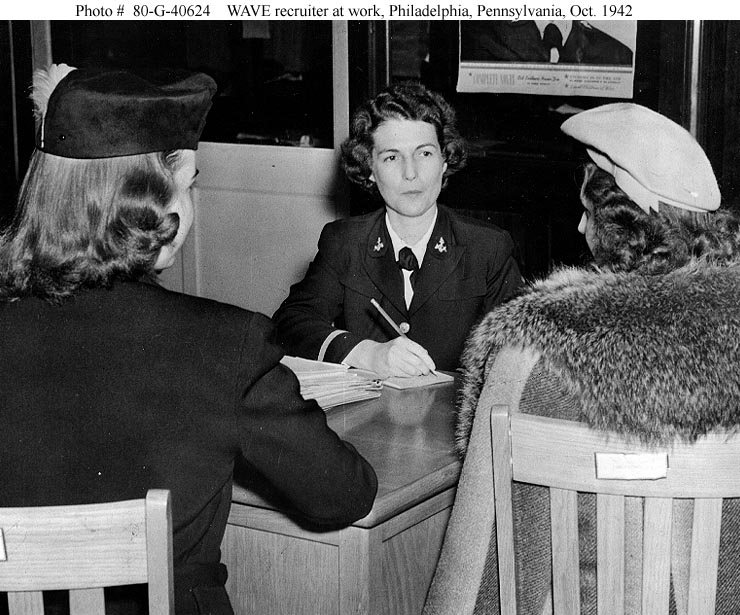
https://www.ibiblio.org/hyperwar/OnlineLibrary/photos/images/g40000/g40624.jpg
Source - Photo #: 80-G-40624 WAVES recruiting activities
Ensign May Herrmann talks to two young women concerning enlistment in the Navy Women's Reserve, at the Officer Procurement office, Philadelphia, Pennsylvania, 30 October 1942.
Official U.S. Navy Photograph, now in the collections of the National Archives.
Image result for wwii waves recruits
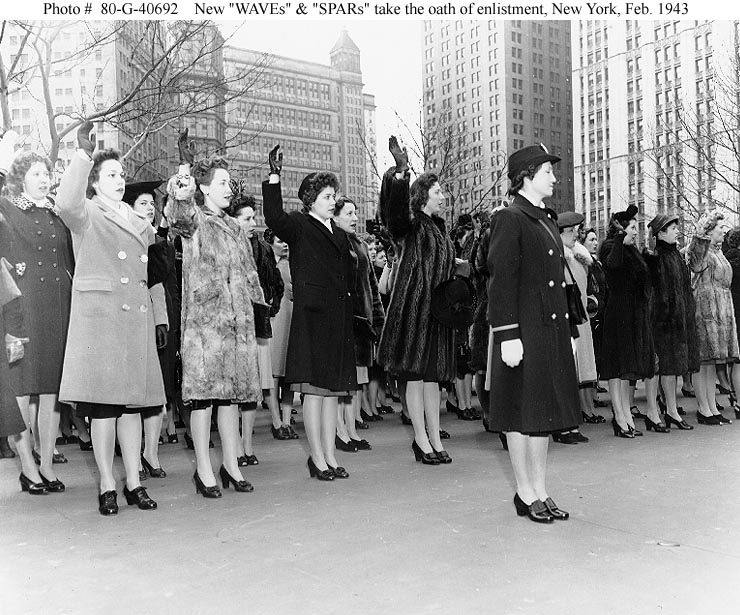
Source - Photo #: 80-G-40692 "WAVES and SPARS Day", New York City
New WAVES and SPARS take the oath of enlistment in a ceremony held in front of New York City Hall, 8 February 1943.
Official U.S. Navy Photograph, now in the collections of the National Archives.

Related image
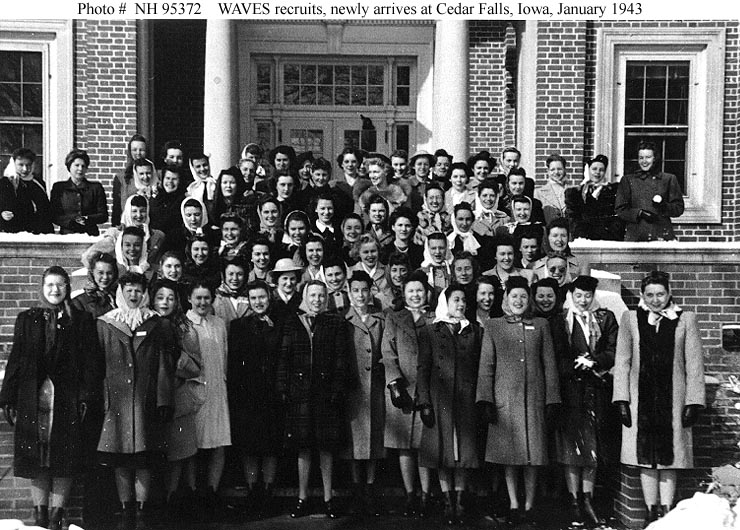
Source - Photo #: NH 95372 Navy WAVES training school, Iowa State Teachers College, Cedar Falls, Iowa

Newly-arrived WAVES recruits pose for a group portrait at the school, before the arrival of their uniforms, January 1943.
Shirley Feldstein (Bell) is 3rd from right in the front row, with a white name tag visible on her coat.
She comments, on the reverse of the original print: "We all look like penguins ready for a slide in the snow".
Donation of Shirley Feldstein Bell.
U.S. Naval Historical Center Photograph.

The easiest and least expensive way to start your WAVES impression is to wear 1940s civilian clothing along with an enlistment pin. The shop Peachy Keen sells them for a few dollars. (They also sell a bunch of other cool stuff so be sure to look through the whole shop!) If you have an interest in WWII reenacting, chances are you already have a basic 1940s outfit. If not, start with a pair 1940s style high waist pants or an A line skirt and a basic 1940s blouse. Add some basic accessories and you are on your way!

If you sew, I highly recommend Wearing History's Smooth Sailing Togs. Go with the e-pattern if you are really on a budget. A simple, but well put together civilian outfit, with a handful of period correct accessories, will take you a long way and will work for many WWII era living history impressions.

By adding a WAVES enlistment pin, you can portray a new WAVES recruit on your way to basic training while you continue your research and save up for those first uniform pieces!

Smooth Sailing Trousers (shown with Smooth Sailing Blouse AND Blouse from Sailor Girl Playsuit)
Sports Togs Paper Pattern: http://wearinghistory.clothing/smooth-sailing-1930s-sports-togs-pattern/
Epattern:
Sports Togs A: http://wearinghistory.clothing/e-pattern-size-pack-a-smooth-sailing-1930s-sports-togs-pattern/
Sports Togs B: http://wearinghistory.clothing/e-pattern-size-pack-b-smooth-sailing-1930s-sports-togs-pattern/
Pins available through Peachy Keen
Shoes and blouses are the easiest places to save a few pennies. Look around on Ebay and Etsy for good deals on vintage shoes but also check your local antique shops, thrift shops and flea markets. Places like Amazon offer basic black oxfords at lower prices but watch the height and shape of heels as many are not period correct. However, if you can grab a basic, so-so correct pair for say, $25 or $30 do it. You can always upgrade later. WAVES shoes, worn with everything except the white uniform, should be a plain black lace up oxford style with low heeled (1" to 1 /12") and closed toe. Though some women wore privately purchased shoes that had a small amount of perforations (decoration), try is go as plain as possible. The standard issued shoes were plain, and yes, kind of ugly.

The best option on the market right now for reproduction oxfords are the O.A.O. Oxfords from All Heels on Duty. The are a direct copy of WWII women's military footwear, are solidly made, and super comfortable. These will serve you well for everyday vintage wear as well as both your 1940s civilian and military impressions. (I hear their next style will be the military heeled pumps!!)

Image may contain: one or more people, people sitting and shoes
Imaging showing a WAVE polishing her standard issued oxfords.

Style A is want you want to look for, though a slightly lower heel would be good. Image from Glamourdaze
White cotton blouses (worn with both the blue and white WAVES uniforms) can be long or be short sleeved, with a yoke if possible, and free of any kind of trim or embellishments. The most important thing for the blouses is the collar shape. It should be pointed and the blouse must button at the neck to allow it to be worn with the tie.

Early war ties for the WAVES are two pieces and button at the sides of the neck under the collar. You can add these buttons to a new blouse in a flash. Another thing to keep in mind if you are on a tight budget is that your reproduction white blouse and shoes can double for civilian wear! Score!
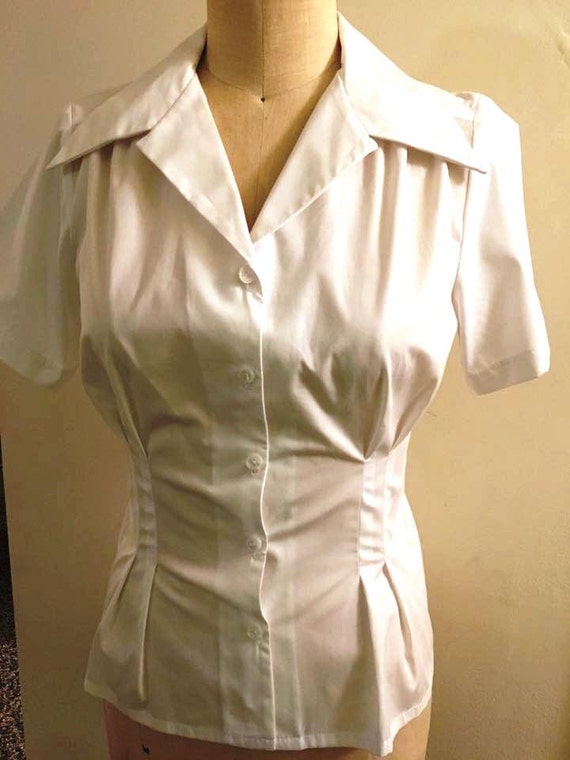
Blouse from Nudeedudee on Etsy

Notes on Sewing Your Own Uniforms

There are no patterns on the market for WAVES uniforms, though a highly skilled seamstress can draft patterns from originals.

As these are military uniforms, the materials used and construction details are very specific! Finding the correct materials for the blue wool uniforms and the cotton seersucker uniforms will be challenging but not completely impossible. I highly recommend examining originals (or high res photos) to gather information about the cut/fit and fabrics used. Invest in an original hat (overseas/garrison or soft crown with the WAVES tally), patches for the collar and buttons to complete the look if you are sewing your own inform. These will help immensely with giving an authentic look and feel. You can also take these items with you to fabric stores to help guide your search for fabric. Both the overseas/garrison caps in wool and seersucker, as well as the seersucker rating patches are the same materials as the rest of the uniforms. The blue rating patches for the most part are the same too.

Ordering fabrics online for any sewing project can be frustrating, so I highly recommend ordering fabric swatches first to match the correct color and weave.

----------

I hope this mini introduction into WAVES uniforms is helpful! Our next WAVES post will cover research materials. Future posts will also go into more detail about uniforms, how they are worn and what to look for when shopping for originals!

Have a research question about the WAVES? Ask away! 


Thursday, February 1, 2018

WAVES - Women Accepted for Volunteer Emergency Service (Blog Series)

Hello all, 
Wow, is it really February already? I'm OK with that because it means spring is just around the corner, and I'm ready for some warmer weather. One of the things I mentioned in my last post, one of the things all be working on in 2018 is sharing more information about the WAVES during WWII.
This is the first of several planned posts. To start, I thought I would give a brief overview of the WAVES and some basic facts. Later on I will have some more in-depth posts that discuss uniforms, various jobs, personal experiences of WAVES as well as what it is like to be a WAVES reenactor. I will be teaming up with my friend Sara from the Canteen Cowboy on some of these. I hope you will follow along!  

Recruiting poster for the U.S. Navy WAVES (Women Accepted for Volunteer Emergency Service) during world War II. Illustration by John Falter, 1943.
Pinterest
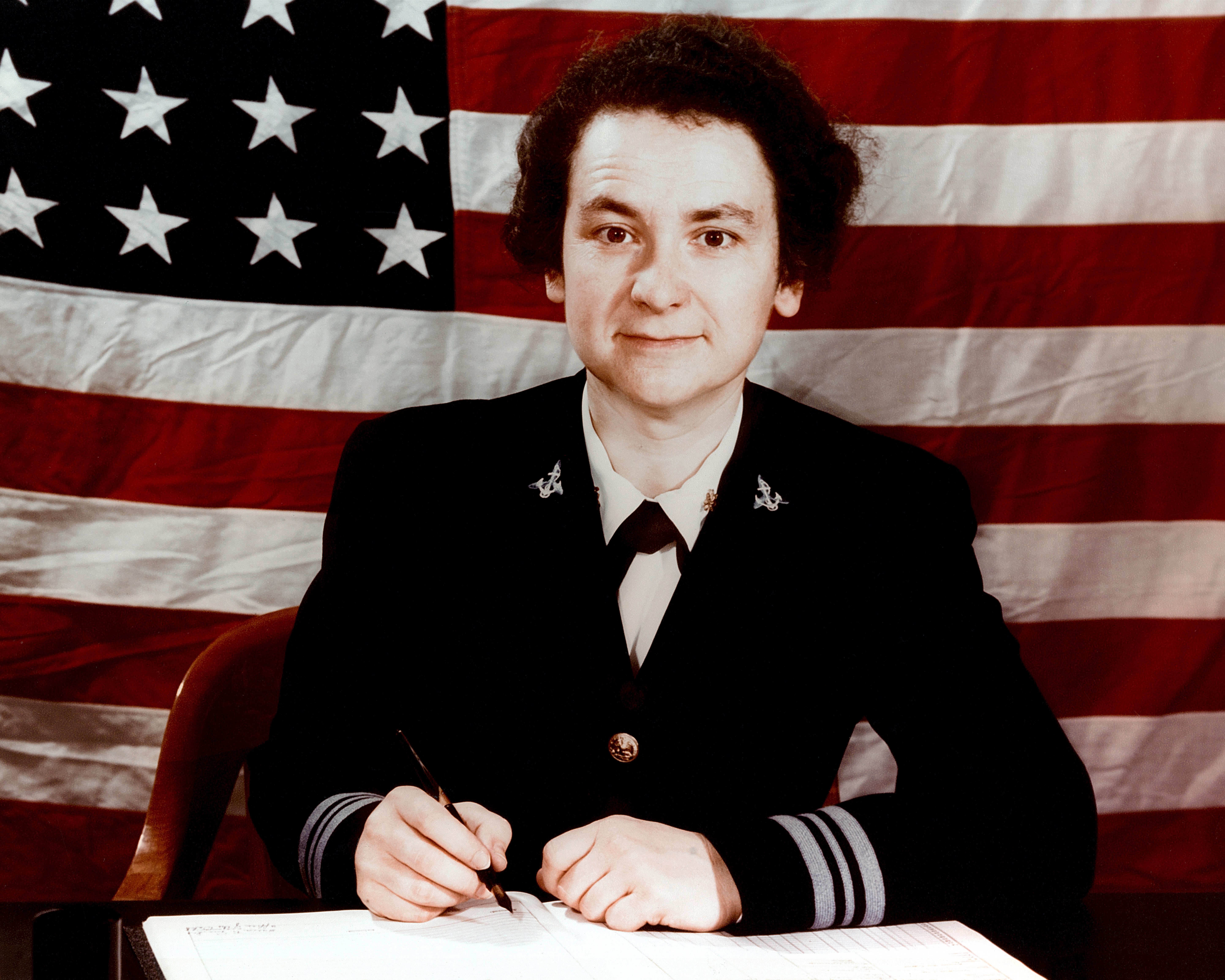
LCDR McAfee while director of the WAVES - Source
The WAVES (Women Accepted for Volunteer Emergency Service) program was created in July 30, 1942 as the need for additional military personnel grew during World War II. The WAVES were an all-woman division of the U.S. Navy with its members holding the same rank and ratings as male personnel. WAVES also received equal pay and were subject to the same military discipline as male personnel. 

The Women's Reserve of the Coast Guard (SPARS) was created on Nov. 23, 1942 "to expedite the war effort by providing for releasing officers and men for duty at sea and their replacement by women in the shore establishment of the Coast Guard". The first 153 enlisted SPARs and 15 SPAR officers were former WAVES who agreed to be discharged from the Navy and join the Coast Guard.

WAVES and SPARS duties were restricted to the continental U.S. until late in 1944, when overseas service was finally authorized for the WAVES. Even then the WAVES were restricted to the U.S. territories of Alaska and Hawaii. While many WAVES filled traditionally female secretarial and clerical jobs, thousands more served pushed the gender barrier and took on duties in the aviation community, Judge Advocate General Corps, medical professions, communications, intelligence, science and technology.  Aviation Machinist's Mates, Aviation Metalsmiths, Control Tower Operators, Aerographer's Mates, Link Trainer Instructors, and Parachute Riggers are just a few of the duties performed by WAVES during the war.

At the end of World War II, there were over 8,000 female officers and as many as 80,000 enlisted WAVES, equaling roughly 2-1/2 percent of the Navy's total strength.

Fast Facts
  •  In August 1942, Mildred McAfee, was sworn in as a Naval Reserve Lt. Commander, becoming the first woman commissioned as an officer of the U.S. Navy. 
  • Within the first year, over 27,000 women joined the WAVES. 
  • The notable New York fashion house, Mainbocher, designed the WAVES uniforms. The design services were secured through the efforts of Mrs. James V. Forrestal, wife of the Assistant Secretary of the Navy. 
  • By mid-1944, the WAVES began accepting African-American women. Harriet Ida Pickens and Frances Wills became the Navy's first, and only, African-American WAVES officers in December 1944. Approximately one in every 36 women who enlisted and trained for the WAVES was an African-American. 
  • As many as a third of all WAVES were assigned to naval aviation. These women fixed aircraft, packed parachutes, provided weather information, served as link trainer instructors, gunnery instructors, coordinated air traffic from control towers and a performed host of other aviation-related jobs. 
  • By 1945, enlisted women could choose from a total of 38 different ratings in the Navy. Almost every shore establishment had WAVES on active duty fulfilling necessary military work of every kind, from general office workers and supply accounts specialists to film projectionists and drivers to dental prosthetic technicians. At the Navy Department headquarters in Washington, D.C., over half of all service personnel were WAVES. Approximately 70 percent of the Bureau of Naval Personnel was composed of WAVES. Large numbers of WAVES were assigned to the Hospital Corps where they participated in Navy recovery, therapy and rehabilitation programs. 
  • By the end of World War II, the WAVES consisted of 8,000 female officers and close to 80,000 enlisted women.
  •  By September of 1946, the majority of WAVES were either discharged or released to inactive duty. 
  • Despite their involvement in World War II and post-war, the organization was disbanded in 1948 when the Women’s Armed Services Integration Act was passed.  This new law permitted women permanent status within the armed forces.  Despite this change, the acronym WAVES continued to be used for almost 30 more years.    

Wednesday, April 27, 2016

18th Century Feathered Hats

Here is a little research project I've been working on lately. Although I don't get to attend 18th century events as much as I would like to, the time period is never from from my mind. I like keep up to date as best I can on what's happening in the reenacting world, the trending research, new sources etc. There is always something new to learn.

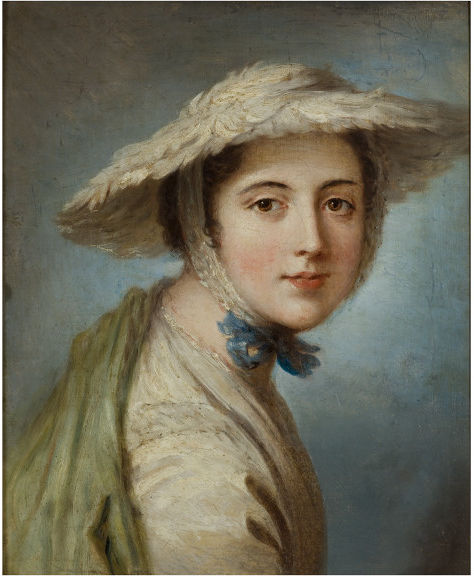
Lately I've been looking at 18th century hats, in particular those covered with feathers. Why I'm drawn to these I'm not entirely sure. Whether something like these would be appropriate for my typical living history portrayal remains to be seen and more research is certainly needed. My guess is that for a British camp follower in the years covering the 1750s to 1770s a fine feathered hat would be very unlikely. As an up middle class resident of say, Boston, they are a possibility. But as I said more research is needed. I have been researching in the historic newspapers without much luck as of yet. However, in the world of historic costuming and fancy dress events, pretty much anything goes. :)

Here are a few examples of feathered hats in period art.

Oil painting, 'Head of a Girl Wearing a White Hat', ca. 1760-70, by William Hoare RA (1707-1792) V&A 833-1873
It looks like this young lady is also wearing a feather covered hat. Yes?

Philip Mercier (circa 1689-1760) - Source

And here are some serving hats in museum collections. All are dated to about the same time as the artwork above, 1750-1770 and are very similar looking. They are all around the same size too, approximately 13" to 14".

A round hat with a shallow crown and wide brim decorated with cock and guineafowl feathers in natural colours and dyed blue, yellow, red and green. The feathers are stitched to a linen ground which is lined with blue taffeta. 1750-1770 (made) V&A T.90-2003
Woman's feather hat (bergère) English or French, 1750–75. Round disk-like hat with crown only slightly elevated, foundation of linen completely covered with polychrome feathers; lined with pale pink taffeta, one pale pink silk ribbon. MFA 43.1832
Here are two more images of the same hat from the MFA. I find it interesting that you can see the edge of the straw base as well as the stitching on the underside. Zoom in for a closer look.

MFA 43.1832
MFA 43.1832
Although this next hat is a little different, only the brim is covered in feathers, it gives me hope for wearing a feather covered hat for living history events. The description says it was made in France but it's place of use was Boston.

MFA, accession number 49.916
Making a similar hat I believe would be very doable, though time consuming. I have a plain straw hat with a very low crown that could be used as a base and colored feather can be purchased at several places like Joanns. I also have left over silk taffeta to line the underside of the hat. Would I glue the feathers or stitch them in place? I'm not sure yet, likely I'll stitch them, but if I do attempt a crazy project like this you can be sure to read about it here. :)

If anyone knows of other examples, in art or surviving originals, I would love to see them.

Wednesday, January 15, 2014

Looking Back at 2013 - Also a Belated Blog Birthday!

2013 was an exciting year. Lots of sewing projects, traveling, and adventures to be sure. I've already posted a recap of my sewing projects from 2013 which you can read about in this post.

It's hard to believe I've only been blogging for two years. January 3rd was my two year blogging birthday! Hooray! In honor of my blog birthday I decided to put together a little recap of blogging news and some of my posts that received a lot of attention in the last year. It's been fun for me to look back. I hope you enjoy too. :) I have some really fun posts planned for this year so I hope you will continue to follow along.

Awards, Events, Special Announcements in 2013

January 
March
April 
May

June   
  • A crazy month! It was my friend Erin's wedding and also the month that Cori and I had to move out of our apartment. I really miss that place and all the closet space! 
  • Not much in the way of events although I did manage to spend one day at Fort Ticonderoga working in their shoe shop. 
  • I also got together with Rebbecca of A Fashionable Frolick to continue working on our18th century shoes with Mr. Walker. (See Rebbecca's post here.)
Working on my shoes at Fort Ti. Photo by Driftingfocus Photography
July 
August 
September 


October 
  • Went to a WWII event in Stow, Mass. - More photo to come!
  • Photo shoot with Cori - More photo to come! 
This is just a sneak peak at the event. I have lots more photos to share.
December 

Popular Blog Posts for 2013
    My research posts have been popular as well. I didn't write as many this year so my recap includes those from 2012 as well as 2013. 


    Sunday, January 12, 2014

    Figured Silk Shoes

    One of my very first blog posts was about 18th century shoes, (see Trending - 18th Century Shoes) not surprising as I had recently attend a workshop on making 18th century shoes. Since that workshop I've spent a lot of time looking at images of 1750-1780 era shoes. I've been saving images of shoes that I have found with a similar figured silk design. Some of the silk looks like little diamonds, on others the pattern looks more like stars. I'm amazed at how many pairs I've come across and in so many different colors too.

    lacmacloseM.67.8.129a-b
    A close up look at the silk here shows the figured silk pattern to be more star shape then diamond. You can see too that these shoes are lined in linen instead of leather. They also have an extra insole of linen. Another thing I really like about this pair shoes, aside from the color and pattern, is the dog leg stitching used to reenforce the area where the uppers and vamp are sewn together. In earlier shoes you would see this covered with binding. It's interesting that the maker decided to use white thread. It would appear that this was done at the same time the binding was added.

    LACMAC M.67.8.129a-b
    Examples of the dog leg binding detail on earlier shoes. Oh and check out all those TINY stitches around the heels! The green pair are dated 1730–55 while the yellow brocade, according to the MET, are dated to 1760–80. I think they look more 1730s/40s with the chunky heel and silver embroidery.

    MET 2009.300.1412a, b
    MET 2009.300.4132
    This 1780s pair from the MET has the same treatment as the blue pair above.

    MET 2009.300.4749a, b
    The shoe binding is not only decorative but helps give strength to the seams of the fabric uppers of the shoes. Again the mis-matched thread which convinces me that this step was in fact done at the same time the bidding was added. Why change threads colors when you already have some in your needle? Also why pay for a separate color thread? We modern seamstresses like to have everything match. Today thread is (relatively) cheap but that was not necessarily the case in the 18th century. I'm sure there would have been an additional cost if the wearer really wanted that thread to match the fabric of her shoes. It's neat to see this on more then one pair of shoes.

    MET 2009.300.4749a, b
    Here are two more pairs of shoes with similar fabric from the 1780s/90s. Both are from the Russian Shoe Museum. These sky blue figured silk shoes from are French with an Italian style heel. The pink pair, also with an Italian heel are listed at being from Great Britain. Note again the thread color. No dog legs binding here, as it has fallen out of fashion by this time.

    Russian Shoe Museum id 1134
    1780s.
    Russian Shoe Museum - Great Britain. c 1790s

    Wednesday, November 13, 2013

    WWII Victory Pins! - Part 2, Sweetheart Pins

    This is part two part of my post on WWII Victory pins. (See part 1 here.) Warning, this post has lots of pictures. :)

    To continue from part one, there are two categories of 1940s era pins that I would call "Victory Pins." These are the various pin back buttons and patriotic sweetheart jewelry worn during the Second World War to show support for your country, the war effort, and of course loved ones in the armed forces.

    There is such an amazing variety of "sweetheart" jewelry! Some pins and jewelry were mass produced while other were homemade, making them extra special and unique. Some of the most common pins were "son in the service" - little red, white, and blue rectangular pins with one or more blue stars in the middle. Some pins even had a photo of the serviceman attached to them. You could also purchase small flags of the same design to hang in your window. Many military families still use these flags today to show support for a son or daughter in the military. "Mother" pins, appropriately made of mother of pearl, were very popular as were pins that featured the branch of service the "sweetheart" was a part of. 

    The following images are examples of some widely produced sweetheart charms as well as more unique and creative patriotic charms I've come across. You can see more "Remember Pearl Harbor" pins here. I would love to have one of these. The one in the college I saw on Ebay. See a lovely collection of original pins here.

    I adore the little solider pin, don't you? All pins in this college found at Anderson Militaria
    All pins in this college found at Anderson Militaria 
    Pearl Harbor pin Ebay, Civil Air Patrol pin Etsy, Clear Lucite heart Etsy, Heart shaped "Mother" pin U S Army insignia Etsy,Mother of Pearl bar pin with U S Air Corps Etsy, Mourning brooch for pilots Etsy
    Pins from my collection
    Ebay
     Celluloid soldier and sailor pins anyone? Oh yes please, these are so neat!

    Celluloid WWII Soldier Pin - Hey Sailor pin -
    Clear Celluloid Sailor - Blue Jeep 
    Red Jeep
    And let's not forget the most basic yet widely recognizable WWII era pin! The "V" for victory!!

    My classic "V" for victory rhinestone pin. I love this pin and have worn to a bunch of times. You've most likely spotted it on a number of my 1940s outfits. :)

    Victory Pin Painted metal United States, 1941-1946
    Source - HistoricNewEngland.org
    Source -Kovels.com


    Red and white Bakelite "V" for victory pin - Source

    Collection of V for victory pins - Source Marshallamericana
    This is an interesting little pin that I purchased on Ebay with an extra bit of patriotic flare! It's actually a combination of two pins. This first being the 3rd Liberty loan pin back button made from celluloid featuring a large "V" and two radio towers on the sides. There is also the Morse code for V "..._" on top. The second pin is the little hand painted metal soldier. Someone combined the two with a small piece of red, white, and blue ribbon, how neat! The ribbon is a bit delicate and as the metal soldier has some weight to it I don't think I would wear this pin for an event for fear of having the ribbon tear.


    I hope you have enjoyed my two posts on victory pins. Pins of course were not the only item of jewelry worn. I have seen many examples of necklaces and bracelets too. Even a few sweetheart handkerchiefs. You can view some here. Have some patriotic jewelry of your own? I would love to see it!
    Related Posts Plugin for WordPress, Blogger...