Showing posts with label Behind the Seams. Show all posts

Monday, March 21, 2016

Behind the Seams - 1920s Fluffy Pink Robe de Style

Greetings all! Welcome to another "Behind the Seams" post. I have recently returned from a fabulous 1920s themed event and still have flapper fashions on my mind. So, today I'd like to share another 1920s piece in my collection, a fluffy pink robe de style. I really adore this dress! Sadly, it's badly worn in certain areas and can no longer be displayed on a dress form. But it's still a beautiful piece to study.


This particular dress is made from a light weight and very crisp silk taffeta. The tired skirt is trimmed with multiple rows of matching taffeta and tulle mounted on a silk base. The bodice is constructed in very much the same way as my black silk robe de style and closes at the sides with metal snaps.

This dress would be very easy to recreate. The bodice is 16 1/4" and the skirt is 23" long (29"including the last layer of tulle which hangs a little below the silk base.)

Skirt is made of a base of pink silk taffeta and a second layer of tulle with alternating rows of tulle ruffles and silk ruffles mounted on top. Each tulle ruffle is approximately 6 1/2 deep and the silk ones are 5". There are four tulle ruffles and three silk ones.

The silk skirt is 15/1/4" across the waist, 23" long and 35 1/4" wide at the base. It measures approximately 86" around the bottom. The whole dress is sewn with 3/8" seams.

Back of the dress
The neck and arms are bound with self fabric. There is piping at the waist and along the top of each silk ruffle. The neck is also trimmed with tulle.

Close up of neckline.

The large matching bow is quite lovely. Each loop is about 6 1/2", the center is about 2" and the tails are 15" long.


Here you can see the side that closes with metal snaps. You can also see how the silk is really starting to split.


I love this shot of the ruffles on the skirt. The bottom edge of each silk ruffle is frayed, which I think was intentional as they are all like that. The tulle ruffles are each hemmed/trimmed with gold thread.


What makes this style of dress really unique and fun are its underpinnings. Some robe de styles were worn with separate hoops underneath but my dress has them sewn into the dress itself. The hoops, though a bit crushed, are very similar in style to pocket hoops of the 18th century. These are made of a rectangular piece of tulle that is pleated at the top and has metal boning across the bottom.

The hoops measure approximately 6 x 10 and are gathered to about 3 1/2" at the top.


I hope you have enjoyed this latest addition of Behind the Seams!

Wednesday, August 26, 2015

Behind the Seams - 1920s Black Silk Robe de Style

As promised here the second, of what I hope to become many, Behind the Seams blog posts. This series of posts will examine in detail some of the vintage and antique items I have collected, or in some cases been gifted, over the years. My goal with these posts is to show you the nitty gritty details not often shown on other blogs or even museum website. How many times have you looked at an image of a vintage or antique garment and wondered "How did they make that?" "What does the back of the garment look like?" "What does the inside look like?" "How are the seams/hems etc. finished?"  I could go on!

One of the reasons I love "old stuff" is the attention to detail and the quality of the materials used. As a vintage sewing and historical costumer I know how difficult it can be to find just the right material for a project. Cost of course is a big road block. Many fabrics and trims, for example, that were common place 50, 100, or even 200 years ago are virtual unheard of now. Try finding calimanco at your local fabric store! Even the most simple garments were beautifully made because they were made to last too! Not something that can be said about most clothing sold today.


So here we go. Today's post is all about this black silk taffeta dress from the 1920s. The style is known as a "robe de style." I talked briefly about the robe de style in this post way back. Beautiful examples can be found in museums all over the world. (Ex. here, here and here.)


If you have not seen Katherine's stunning robe de style please do so! She also has a blog post here about making the small hoop to wear under the dress.

I've made two robe de style dresses using this pattern from the page Dress Making Research. The first is certainly nothing to brag about. It was an awfully poly thing made as a Halloween costume. It looks fine in pictures but I never really liked the look or feel of it. The second I helped make for a friend. We used cotton but did not include any kind of hoops or pockets. Those are something that can always be added.


Black Silk Taffete Robe de Style with Scallop Hem
The Details
Length shoulder to hem -
Across shoulders - and width between shoulder straps -
Under arm to under arm -
Under arm to drop waist -
Shoulder to drop waist -
Drop waist to hem -
Width at hem -
 10 Scallops at hem
7 rows of shirring at each hip
15 rows of cording, each cord is 1/8"
9 of snaps at side, and 2 at left shoulder


Simple design with nice details. It's made of silk taffeta and void of trim except cording and shirring. The cording appears to be cotton but it's very difficult to tell. No evidence of hoops or pockets but the dress most likely would have been worn with some kind of hoop underneath to give the skirt shape. The neck, arm holes, and scallop hem are all bound with strips of bias fabric. There is a single piece of piping at waist. The dress closes at the left side and shoulder with small metal snaps. Thread appears reddish brown in areas.

This dress does need a little repair work but nothing too major. 


Monday, June 1, 2015

"Behind the Seams" - 1860s Swiss Waist in Electric Blue

Greetings all! Today I begin the first of a new series of posts I'm calling "Behind the Seams." I hope to feature a different item each month! In these posts I want to show a few of the more interesting details of some of my vintage and antique garments. Creating each post is proving a little more time consuming that I originally planned but I think all the extra work will pay off in the end. I've always been interested in knowing what the insides of older clothing looks like, how it's sewn, etc. and really want to be able to show those details as best I can. Each post will include LOTS of photos. I'm not really sure how many is too many so your feed back will be most welcome. (Can there really ever be too many photos of an awesome vintage/antique dress?)

I would also like to hear from you, dear reader, what it is you would like to see. What kind of construction details are you most interested in? Any particular time period? Most of my collection is 1920s or newer but I do have several older pieces, such as the one featured today, that I think everyone will enjoy seeing.


This incredible little piece was a surprise find at an antique shop a few years back. I was on a mission looking for hats and was poking around a rather cluttered antique shop (the best kind) when I spied something bright blue a corner. And I mean bright, like electric, blue! Expecting a hat or scarf of some kind I pulled out this little beauty. Most certainly not a hat, lol!


This corselet, or Swiss waist, is a little worse for wear but what a great study piece! A Swiss waist is a boned, pointed underbust garment that was worn over skirts and blouses or dresses. They were very popular fashion accessory in the 1860s. Some even had shoulder straps, like this example. Often called corsages in the 1860s, the terms Swiss bodices, Swiss belts, or Swiss waist belts or simply waists are used to describe the same type of garment. They show up again in the 1880s and 1890s, which is when the name Swiss waist became common. Unlike a corset, a Swiss waist does not fastens with a metal front busk. They have a flat front, with or without a front opening, or can lace up the front with hand worked eyelets. The back fastens with lacing.

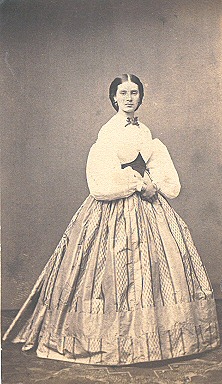
Black was a common color as seen in the print below. But many surviving examples, like mine, indicated that some women were not afraid of color! Or patterns! Check out this crazy plaid and paisely silk waist at the The Fenimore Art Museum. Also this one in teal.

(Godey’s, August 1862)
The inside of my waist is lined in dark blue cotton and each seam is stiffened with 1/4" wide baleen. I know it's baleen and not metal because you can see it in spots where the lining is torn or worn away.


The waist closes with 5 hooks and eyes and has 11 eyelets for a cord which is now missing. Each tiny eyelet is only about 1/8" in size and beautifully sewn. The hooks and eyes are most likely a more recent addition.


The edges of the waist are bound with self fabric piped with a narrow cotton cord. Piping was a very common detail on 19th clothing. The waist is also trimmed around the edges with self fabric ruching that is 5/8" wide.


 The eyelets are tiny but bound very neatly. This was made for a tiny gal! When laid flat it measures 24 1/2" long about 9" high at the center from. The back is slightly shorter at 7 3/4". The narrowest part is 2 5/8". It is made of 7 sections. I found it interesting that white thread and a darker brown thread was used to construct the waist. The modern seamstress it taught to use matching thread for her projects so the stitches are not as easily seen. However, on close examination, even on the front where the trim is attached, you can see the stitches. To me this is a good glue that this was something made at home rather then a professional, but I'll admit I have no documentation to support that.


I plan to make a pattern from this someday but I think you could easily draft one yourself from the measurements I've given. If you can't wait, don't worry! Katherine of Koshka the Cat has a pattern drafted from a waist in her own collection. The size and shape is a little different then mine but I really like it.

Source - The Graceful Lady
Source
Related Posts Plugin for WordPress, Blogger...