Showing posts with label 1760s. Show all posts

Saturday, January 23, 2016

Two Silky Winter Projects

I has silk!!! Mawhahahaha! One of my New Year's resolutions last year was to sew one thing that's truly amazing. Of course this meant breaking resolutions 1 and 2, not buying new fabric and sewing practical things. But last fall proved a surprisingly successful month for Etsy sales so I decided to treat myself.

I've been itching to make a new 18th century silk gown for a while now and really wanted to try the new "fashionable" gown pattern by Smith and Larkin. Searching for an ideal striped silk was a challenge and I had almost given up until I found this amazing silk from Duchess Trading on Etsy. It's perfect!! A touch more pink then it looked online but still very nice. And because I was a returning costumer I was able to get a small discount, always a plus! I even picked up a few silk ribbons! If you are searching for vintage ribbons, flowers, lace etc. for your next project I highly recommend Duchess Trading. Shipping is fast and the owner is fantastic to work with! :)


I've made two 18th century silk gowns but both were solid colors (ivory and green) and I felt it was time to do something a little different. The fashionable gown pattern by S&L is ideal for narrow stripes so stripes it will be!! I should have enough for a matching petticoat too, though I might have to piece the back section with a different fabric.


While searching for silk stripes I was bad an also bought this AMAZING silk plaid! Along with patterns and kits, Smith and Larkin offers a nice selection of fabrics. Go check them out!!


Referred to as "cross barred" in the 18th century, my plan is to use this plaid silk for a 1760s sacque gown. There are many beautiful extent plaid gowns in museums and other places around the web. Not only that, but take a look at this nearly identical silk pictured in Selling Silks: A Merchant's Sample Book 1764 by Lesley Ellis Miller. I will be posted a full review of this book sometime this winter! (You can view the original book here.)


I was only able to purchase 6 yards which will, just barely, be enough for the gown. But I believe that either the ivory or green silk petticoats from my other two gowns will work nicely with this silk plaid. So, now I need to look through my stash to see what I have for linen that will work for lining the bodice of each gown. Oh and silk thread too..... Other then that I should have everything I need to get started!

I plan to take my time with each of these gowns. I don't have any specific events coming up to wear them to so there is no need to rush. I'm not even going to set a deadline for having them finished. There are a few projects that will have deadlines this year so it will be nice to have something relaxing and fun to work on in between my other sewing madness. Honestly, if I have one close to finished by the end of the year I will be happy. Details, details, details!! That's what these gowns will be about. So, you can expect a few blog posts on each of them as I work. )

What sewing projects do you have going this winter?

Saturday, August 29, 2015

French and Indian War Event at Crown Point

My living history hobby began in the 1860s but transitioned back to the 18th century. Then it suddenly jumped forward to the 1940s. Today I find myself attending more 20th century events but I always seem to find my way back to my favorite time period. I have a deep love for the mid 18th century for a number of reasons. I find the history fascinating, it's when America  as a country was really born after all. The clothing is intriguing and enjoyable to both wear and to create. But it was through 18th century living history that I met my husband Cori. We have both made so many life long friends through our crazy hobby.

Photos in this post photos courtesy of Kris Jarrett Photography and Media Production. Thanks Kris! (Kris is also the talented man who took out wedding photos which you can see here and here.)


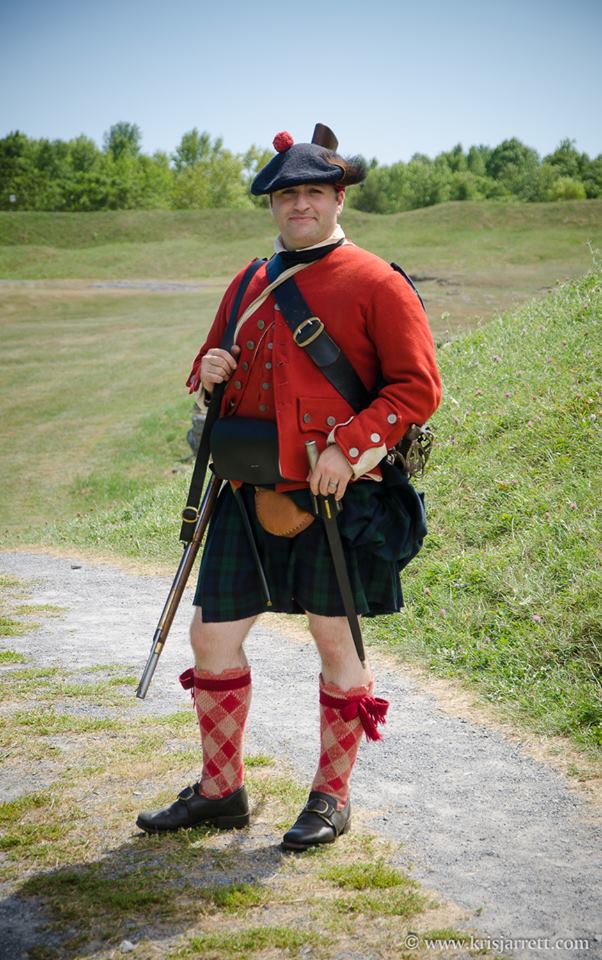
And who doesn't love a man in a kilt? Cori's main impression for the French and Indian War period is a soldier of the 78th Frasier's Highlanders. This particular regiment, with an impressive record, was formed mostly of former Jacobites. They served with distinction at the Siege of Louisbourg in 1758 and again on the Plains of Abraham when the British finally captured Quebec in 1759.


This summer we had the chance to visit one of our favorite locations, Crown Point, for a French and Indian War event. It's right on the shore of Lake Champlain. We were only able to stay for the day but it's also one of our favorite places to camp. After visiting with friends we headed into the old fort for some photos.

Originally the site of the French built Fort St. Frederic, the area was taken over by the British who began building their own fortifications around 1759. The site served as a major base of operations for British forces for the remainder of the the French and Indian Wars. It was also the end point of the famous Crown Point Military Road, which was built through what is now Vermont. Crown Point was occupied by General John Burgoyne's army in 1777 after American forces evacuated Fort Ticonderoga to Mount Independence. The barracks are mostly in ruins today due to fire.


It's was very windy! You can see we needed to hold onto our hats!


I wore my favorite gown. I've posted a few times about this gown, here and here. I also wore my linen and yellow silk mitts.


 And a few silly ones. Because these describe us perfectly. :)


"I'm not touching you!"
Yup, this is us. :)

Sunday, May 3, 2015

A Proper Look at the Check Gown

This is an older project but one I realized, after a recent Facebook discussion on 18th century crossbarred gowns, that I have not properly shared. This post has actually been sitting, unfinished, in my draft folder for quite some time so I figure it was about time to complete it. Also, it has been a while since my last non-vintage post. I first blogged about my blue and white crossbarred gown here. And you can read a little more about my research here.

The  inspiration.
The black and white print, Native Meltons, by British artist Richard Houston (c.1721-1775). Which is based on the painting, The Oyster Girl, by French artist Philippe Mercier (1689-1760). The original painting by Mercier was sold by Christies in 2013.

Painting - "The Oyster Girl" by French artist Philippe Mercier (1689-1760).
Print - "Native Meltons" by British artist Richard Houston (c.1721-1775) Fitzwilliam Museum
Second print

A young woman standing beside a window at a table, a basket by her right elbow, opening oysters and putting them on a plate in front of her, looking up towards the veiwer, wearing a wide-brimmed hat over a frilled cap; after Mercier.
Mezzotint
Print - "The Fair Oysterinda" British Museum
"The oysters good - The Nymph so fair! Who would not wish to taste her Ware? No need has she aloud to Cry'em Since all who see her Fare must buy'em.' "

The fabric.
You will notice that my fabric has one extra vertical stripe so it's not a perfect match to the print/painting. Pretty darn close though! As I mentioned in my first post about this gown, I bought the fabric long before I found the painting/print. Here in New England there used to be an annual gathering called the Women's Winter Weekend. It was a chance for the ladies to get together for a couple days and share research, period recipes, patterns, and various 18th century sewing and crafting skills. It was also a chance to purchase fabrics, trims, books, etc.


Gown construction.
I had made a few gowns before this one, but mostly with solids and one with stripes. I feared the checks on this fabric would be difficult to work with but found the opposite to be true. Plus the linen itself was a dream to work with. It didn't hurt that I had some very talented ladies helping me out! A very large portion of this gown was constructed during a Hive workshop with the ladies that run Larkin and Smith. This gown is made very much like their new gown pattern.

The lining is constructed first using a firm linen fabric. The back of the gown has a center back seam and the side seams are lapped. Next I cut the panels for the center back and skirt, having measured from the base of my neck to a few inches above the floor, and from my waist to a few inches above the floor. The skirt panels were seamed with the long running stitch and then set aside. It's important to note that if you plan to wear any kind of hoop or bum roll under your gown you need to take those measurement over them. Since I planned to use this gown for a gowning class impression I didn't bother with either of those.

Setting the sleeves.
You can set the sleeves of an 18th century gown yourself if you have a dress form, but it's certainly easier if you have someone to help you. This is a nice close up showing the pleats and basting stitches on the sleeve head. This area is then covered with the robings.  


This is a good photo showing the gown front before the robings were adding. You can see the little darts that help shape the bodice at the bust and also the placement of the sleeves. I was wearing my old stays for this workshop. The gown fits a little differently over my new ones.


Adding the robings
The robing are just stripes of fabric sewn into a tube and then tacked to the gown fronts. On some surviving examples the robings are only sewn to the shoulder area and left floating. We did a pretty good job of lining up the stripes. :)

Adding the gown robings.

Here you can see the neck facing being pinned in place. The edges are mitered to meet the edges of the robings.

Adding the back neck facing
Pleating the skirts.
Here you can see all the pins holding my pleats in place. The gown bodice and pleats are first basted in place. Then the pins are remove. Basting is an extra step but it makes sewing the pleats so much easier and you don't need to worry about pricking yourself.

Pleating the skirts
 Side view


The finished gown. My first outing with this gown was a trip to Colonial Williamsburg.


This has become my favorite gown to wear for events. Because it's linen it is cool and comfortable. I enjoy wearing it with a striped petticoat and printed neckerchief just to mix things up a bit. One of these days I'd like to get the materials together to actually reproduce the print this gown is based on.

Monday, February 9, 2015

18th Century Silk Beauties

Snow, snow, shovel, shovel, snow and more snow. That's been me life in New England lately. I can't complain too much, it's great for snowshoeing! I had a very productive sewing weekend. My plaid jacket now has sleeves! The hood is attached too. :) All that is left to do is finish off the hem and add buttons and button holes. (Sorry, no pictures at the moment.) I also made another blouse using my Hollywood pattern. It's finished too with the exception of buttons and button holes. Can you tell what I don't like to sew? :)

Anyway, today as I was scrolling through my blog feed and FB I came across a link for a recent French auction. What caught my eye at Thierry de Maigret were these 18th century silk beauties. Gowns and shoes, oh my!

Look at these silks!!

Robe à la française 1750-1760 Source

Robe à la française 1750-1760 Source

Robe à la française 1750-1760 Source
How can you not love this?! How pretty this would be for a spring event! This whole thing reminds me of a very tastefully decorated Easter egg. I just wish there was a front view.

Robe à la française 1765-1770 Source

Robe à la française 1765-1770 Source
 Look at the use of fabric on the side of this gown.

Robe à la française 1765-1770 Source
I'm not a huge fan of peach but this gown with it's stripes and floral pattern is pretty darn delightful. The auction listing also provides a nice view of the petticoat.

Robe à la française 1765-1770 Source

Robe à la française 1765-1770 Source
 Only the front portion of the petticoat is trimmed as that is what would be seen under the gown.

Robe à la française 1765-1770 Source
Another beautiful robe à la française 1770. This one with pretty pink trim and a button front stomacher.

Robe à la française 1770 Source
 And then there are shoes. First this pair with embroidery and spangles!! Ooh spangles!

Source

Source

Here is another great example of 18th century shoes in silk with a diamond pattern. I posted about these before here and here. Light blue and sea foam figured silk shoes seem to have been rather popular. They are the colors I've seen the most.

Source
Source

Related Posts Plugin for WordPress, Blogger...