Monday, February 6, 2012

Shoemaking Workshop - Part 1, The Location

I've talked a little bit about my shoemaking experience and will be sharing more soon. But before I go into any details about the workshop itself, I thought I would first share a little bit about the location where the shoemaking workshop was held. 

Last August, Mr. Walker, a shoemaker at Colonial Williamsburg, held a week-long shoemaking workshop at Eastfield Village near Nassau, New York. Eastfield Village is the creation of Don Carpentier. Similar to places like Old SturbridgeVillage in Massachusetts, Eastfield Village is a collection of historic homes and outbuildings that date from the late 18th century to about 1840.
        
“Eastfield is the creation and life work of Don Carpentier, who has been collecting and reconstructing the stuff of everyday life between 1787 and 1840 since 1958. The village is called Eastfield because Don's father gave him eight acres of woodlot near the east field of the family farm in 1971 for the first of his reconstructions: a blacksmith's shop (somebody's pigpen before Don dismantled and hauled it here). There are now more that 20 buildings, including the whale of a tavern.” - From the Eastfield Village website
Brown General Store moved from Minaville, NY,
Each of the buildings are furnished with an amazing collection of antique and reproduction furniture, cooking ware, tools, books, and much more! The village has a fully functional blacksmiths shop, tinsmiths shop, and general store. I spent part of one afternoon exploring a few of the buildings. I didn’t get to go into the general store but did peak through the window!


Eastfield Village is privately owned by Mr. Carpentier and it is normally not open to the public. However, a series of different workshops are held on site each year for those interested in learning historic trades and historic preservation techniques. 
 Here’s a look at the workshops that were offered in 2011

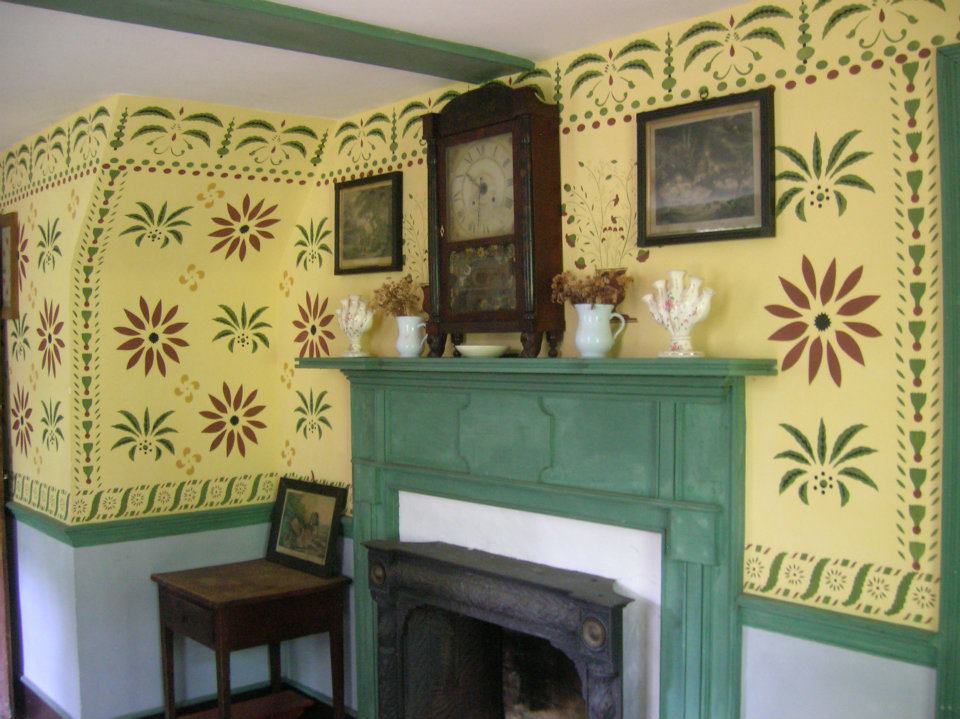
Interior of the Old Tavern
There were nine people at the shoemaking workshop in August but not everyone was able to stay for the full week. Most of us stayed did on site. Our home for the week was the spacious William Briggs Tavern. All of our meals were prepared in the tavern’s kitchen over the fire. There was a large soapstone sink with running water (cold only!) for washing dishes. There was very limited electricity in the building; only a few outlets in one or two rooms and no electric lights. The first night I was there we had a major thunder storm roll through. Mr. Carpentier came into the tavern to get some extra candles and told us the power had gone out. None of us had noticed. We were sitting snug by the fire with a few candles for light enjoying good conversations! 
William Briggs Tavern, my home for the week!
Interior of William Briggs Tavern
Our workshop space was in the ballroom of the William Briggs Tavern. The ballroom was large enough that each attendee had his or her own work space. We had several tables set up and plenty of natural light to work by. During the week, Mr. Walker, who in addition to making shoes for Colonial Williamsburg also teaches one of their weekly dance programs, taught us a few 18th century country dances.
Ballroom inside William Briggs Tavern
Over all it was a wonderful week. Filled with good food, great company, and many wonderful memories! I hope very much to be able to work with everyone again at some point in the future. 
No beer in the kitchen and do dogs in bed!!

Friday, February 3, 2012

What is your favorite Marilyn Monroe costume?

There are just too many great movie costumes to choose from...

I recently watched the movie Gentlemen Prefer Blondes starring Jane Russel and the one and only, Marylin Monroe. Like many of you out there, I enjoy watching these kinds of classic Hollywood films for entertainment but also, of course, for the costumes! One of Marylin's most iconic outfits from this film is the pink dress worn for her "Diamond Are a Girl's Best Friend" routine. But that costume is not my favorite. No, not because it's bright pink .... well, ok that's part of it.
 Image from GlamAmor This covers my Pink for the month of February  :)
My all time favorite Marylin outfit from Gentlemen Prefer Blondes has to be this one. It's rather simple but oh so classy! I wish I could find an image online that was in color. 

I love the little tucks in the dress and the single, long feather in her hat. Her leopard muff and wrap are just stunning.
Here is a look at the costume in action.

Tommy Noonan as "Gus Esmond" and Marilyn Monroe as "Lorelei Lee" in Gentlemen Prefer Blondes
 For a look at more great costumes from Marilyn's movies, check out this page. There are photos of her in costumes from her major and minor movie roles as well as costume sketches by William Travilla.

Thursday, February 2, 2012

Color of the month - Pink

Pink is the color I have selected for the month of February. The first image I would like to share is a painting attributed to Thomas Gainsborough. A artist well known for painting gorgeous hats, the one seen below is certain to please. It's very simple but very pretty all the same. There will be a hat trimming workshop coming up on February 12th. This would be a great hat to try and reproduce. :)

The other thing I love about this painting is the detail in the silk gown. It's not all that often you see a gown painted as something other than a solid or stripe. Even most of John Singleton Copley's gowns seem to be of a solid color. This is a nice representation of what appears to be a painted silk. The V&A has an interesting article here about conserving a painted silk gown in their collection. 
Attributed to Thomas Gainsborough
Here we see the lovely Dorothy Quincy, wife of John Hancock looking pretty in pink. She was painted by John Singleton Copley in 1772. 
MFA, 1975.13
The painting below is appropriately titled "Woman in Pink Reclining on a Canape." It was painted by Theodore Lebrun around 1819. I really like the combination of pink pelisse and and yellow turban. I wonder what book she is reading...
MET 1979.510

I just stumbled across this image from Le Journal des Dames et des Modes the other day. 
From Le Journal des Dames et des Modes, 1913
Here are two stunning examples of pink evening gowns. Both are by 19th century Parisian fashion designer, Charles Fredrick Worth.

        "Worth's designs are notable for his use of lavish fabrics and trimmings, his incorporation of elements of historic dress, and his attention to fit. While the designer still created one-of-a-kind pieces for his most important clients, he is especially known for preparing a variety of designs that were shown on live models at the House of Worth. Clients made their selections and had garments tailor-made in Worth's workshop." - from the MET article "Charles Frederick Worth (1826–1895) and The House of Worth"

Worth gown from 1900, MET 2009.300.1250a, b

Worth gown from 1895, MET 2009.300.2115a, b

Monday, January 30, 2012

Updating the Silk Sacque

To avoid the extra cost of creating a new gown from scratch, many gowns in the 18th were restyled to suit the latest fashions. (Hallie has a great series of posts about that on her blog, Sign of the Golden Scissors.) When creating my silk sacque I wanted a gown that dated to about 1750. The gown was made with large wing cuffs, a matching silk petticoat, and no trim. I have worn the gown a few times now and while I still like the simplistic look of the 1750s, I would really like to update the gown. 
I plan to remove the cuffs and replace them with sleeve flounces. So far I have only succeeded in finishing the new stomacher. Eventually I will add matching trim the gown skirts and petticoat. The inspiration for my stomacher came from this example at the Boston Museum of Fine Arts. As there are no events coming up anytime soon when I might be able to wear my updated gown, I've not been in any hurry to finish it. It's nice to have deadlines to finish a project but at the same time I enjoy not being rushed. 

The overall look that I hope to achieve is seen in the images below. I love the serpentine trims of the 1760s. I will probably only have one tier on my petticoat instead of the 3 seen in the yellow gown from the MET. 
MET 17.120.210

MET 1996.374a–c


Here you can see the trim for the new stomacher pinned in place. I found that extra long quilters pins were helpful in holding the trim in place. I used pinking shears to cut fabric strips about 1 1/2 “ wide then ran a long gathering stitch down the middle. I played with the fabric for a while to get the look I wanted. 


To make the circular trim I used the same technique but placed my gathering stitches along the edge of the fabric strips. I gently pulled the thread gathering the fabric to create each circle. The short ends of the fabric were then sewn together and the circles tacked to the stomacher. To create the different sized circles I varied the width of the fabric. Below you and see the finished stomacher. Also my new stays! (well new as of about 2 years ago anyway. ;) )

Friday, January 13, 2012

On a mission...

It's been snowing/raining all morning and the roads are currently a mess. It made for some interesting drive at 6:00 am this morning, that's for sure! But the little bit of blue sky and sunshine I see out my office window are giving me hope. I'm planning on visiting a few thrift stores and antique shops this weekend and I have a mission! I'm on the look out for a few vintage items; new hat (1940ish), and a new wool coat (preferably 1940s or 1950s). Here's kind of what I'm looking for. Unfortunately, this one sold in 2009. Sad.
1940s coat from DearGoldenVintage
Also on the look out for something 1930s.

1930s white crepe dress, DearGoldenVintage
What I don't need is any more fur ... unless of course its a hat, because I NEED one to go with the mink coat I bought this summer. :)

Related Posts Plugin for WordPress, Blogger...