Thursday, April 19, 2012

Portrait Miniatures - British Soldiers, Part 2

A continuation of my first post on portrait miniatures.

From the Victorian and Albert Museum
A portrait miniature of Colonel Cuppage, painted in 1805 by George Engleheart (1750-1829). And the very dashing Captain W. S. Dawe of the Indian Infantry, painted in 1787 by John Smart (1742-1811).

Colonel Cuppage, c. 1805  V&A EVANS.111
Capt. Dawe, 1787 V&A EVANS.222

Next is one of my favorites - Arthur Wellesley, later the 1st Duke of Wellington. This portrait miniature was painted by Richard Cosway (1742-1821) in 1808. The description from the V&A website reads;

V&A P.6-1941
"This miniature was painted in 1808 and marks the beginning of Arthur Wellesley's famous exploits against Napoleon, who in 1804 had crowned himself Emperor of the French, having brought nearly all Western Europe to his heel. The Peninsular War (1808-14), conducted in Spain and Portugal against the emperor's forces, was a continual drain of Napoleon's strength. It ended with Napoleon's exile on the island of Elba and Wellesley being named the Duke of Wellington. The following year Napoleon escaped from Elba. His final battle with the newly created Duke was at Waterloo (1815), which Napoleon lost."

I'm told that this portrait is one of the few times you see Wellesley wearing his uniform. He seems to have been far more comfortable wearing civilian clothing. 

Below is a nice early miniature of Colonel Thomas Weld, dated 1718. And one of a colonel of the 3rd Foot Guards.

V&A P.63-1987
Colonel of the 3rd Foot Guards V&A EVANS.124
Below - "Portrait miniature of an unknown officer, called 'Thomas Nuttall', dated 1796, watercolour on ivory by Samuel Andrews, (ca. 1767-1807)." 

V&A P.9-1944
Another unknown officer, below right. He is thought to be John Smith Budgen, painted by Jeremiah Meyer, R.A. (1735-1789) in about ca. 1780.

V&A P.8-1960
And my final portrait miniature of the day is of an officer of the 37th or North Hampshire Regiment of Foot, dated 1807. It was painted by Alexander Gallaway.

V&A EVANS.120


For portraits of some dashing Irish officers see -
An Unknown officer ca. 1790-1800. Painted by George Place
Portrait miniature of an unknown officer, 1800-5. Painted by John Cooke (ca. 1778-1805)
Portrait miniature of an unknown man, dated 1768. Painted by Gustavus Hamilton (1739-1775)

Tuesday, April 17, 2012

Portrait Miniatures - British Soldiers, Part 1

Officer of The 55th Infantry
A couple of years ago I found a stunning portrait miniature at a local auction house. The sitter was a young man in a British uniform, brown hair, blue eyes... very dreamy. (Sorry Cori :) ) If I had the money I would have bid on him in a heart beat! I think the miniature sold for around $1,200. WAAAAAY out of my price range. And of course I was never able to get a picture of it. It's possible the auction house may still have an image available, but I doubt it. Lesson learned - Always bring a camera to auction previews! You never know what you will find.

So after viewing Lauren's post on American Duchess last week about making your own miniatures, I decided to do some searching online to see what I could find. What I discovered was a mini treasure trove of portrait miniatures depicting British soldiers. Huzzah! 

My first two finds are from the collection of Thomas Moore Sr. First up is a miniature on ivory of a Royal Dragoon dating to about 1810. The back of the miniature has small lock of hair, most likely belonging to the handsome young dragoon. You see this quite often as miniatures tended to be given as keepsakes to family members and loved ones. This miniature also has an enamel plate on the back with the sitter’s initials. 

Royal Dragoon, c. 1810
The second miniature of Moore's is of Admiral Lord Bentwick dating to about 1800.  This is also done on ivory and like the first, has a lock of hair on the back. Both hair decorations are beautifully done. 


Admiral Lord Bentwick, c. 1800
The Historical Portraits Picture Library yielded several nice finds. Here is a portrait of Captain Horace Beauchamp Seymour (1791-1851), painted by Louis Marie Autissier (772-1830). Autissier was one of the leading miniaturists in Europe and painted several other British officers including the Duke of Wellington. 

Captain Horace Beauchamp Seymour (1791-1851)

The portrait miniature below is of an officer of the Third Foot Guards, now the Scots Guards. The painting is signed 'Cleeve'

Officer of the Third Foot Guards.
Below is a rare portrait miniature by James Heath Millington (1799-1872). The man wearing the uniform of the 2nd (or Queens) Dragoon Guards is thought to be a member of the Lindsell family.

Member of the Lindsell family
From the Yankee Collector, this portrait miniature of an unknown British soldier. The back of the miniature has a lock of hair decorated with gold wire, seed pearls and initials set in a blue enamel oval. Based on the high collar of the uniform and the soldier's short hair and sideburns, I'd date this miniature somewhere between 1790 and 1810. 

Unknown British soldier

Back of miniature

Friday, April 13, 2012

Another Floral Print Gown

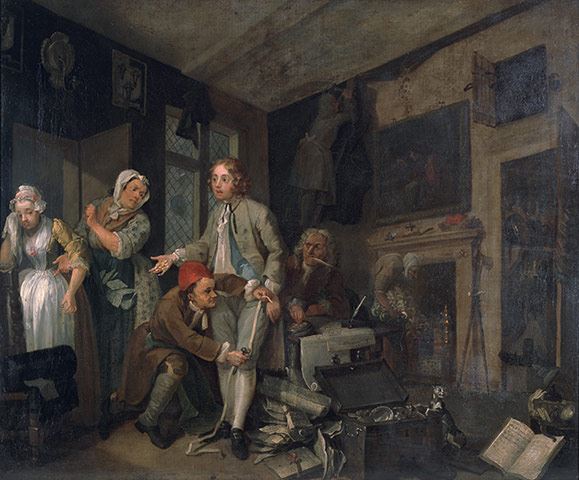
I came across another floral print gown today. The painting is "The Rake's Progress" by William Hogarth (1733). Take a look at the older woman's gown on the left. Another similar floral pattern to the one I posted the other day.
Can't really tell what color the print is. Could be purple or it could be dark blue. What do others think?

 "A Rakes Progress" by William Hogarth

 "A Rakes Progress" by William Hogarth

Tuesday, April 10, 2012

Resources and Inspiration + Gown Update

I thought I would let everyone know that I have added some new sources to my Resources and Inspiration page. New sources include the Russian Virtual Shoe Museum or Shoe Icon website, the National Trust Collections, and links for fashion plates and art galleries.

An update on my purple and white gown ...
After much fussing and practice pinning of the back pleats, I finally cut my fabric. Eeek! That's always the scary part for me. I know I bought plenty of fabric for the gown and I checked my measurements for the back panel and gown skirts multiple times but I'm always afraid of screwing things up when it comes to cutting. It's happened before and I'm sure it's bound to happen again. But for this project, so far so good.

Tate.org
I stitched the pleats of the center back panel to the bodice lining and cut out the panels for the gown skirts. I still need to cut sleeves and the bodice fronts. My plan is to try and match the floral print as close as possible at the side seams. I'm finding the floral stripe on the fabric a little harder to work with than the cross barr'd fabric of my last gown. But the challenge is kind of fun too. I think I'm pretty happy with how things are turning out thus far.

I might be able to squeeze a matching petticoat out of the remainder of the fabric but will have to wait until after I cut my remaining pieces. If I make a matching petticoat I'll most likely need to piece it with some different fabric. I've seen this done a few times with silk petticoats. The back portion of the petticoat that is covered by the gown and never seen was sometimes made out of a different, cheaper fabric. However, I don't know if this was ever done with printed cottons.

I don't have any pictures yet but will try and post some soon.

The image to the right is a detail from a painting by John Hamilton Mortimer at the Tate museum. Although the gown is blue and white, it has a very similar floral print to my fabric. Lots of other great details too. Look at that gorgeous purple work bag! Also embroidered lawn apron and sleeve ruffles.


Wednesday, April 4, 2012

Easter Egg Jackets - IMATEX

IMATEX
Rococo Atelier posted recently about an online searchable data base called IMATEX. This is a new resource for me. I think I spent about an hour or more trying different searches. Not as many whole garments as I had hoped but lots of textile fragments which is nice. Another downside it that there is very little, if any, information on many of the artifacts. However, the pictures on this site are amazing. Each artifact has multiple views and you have the option of viewing most pieces in a standard size or in an extended view. In the extended view the details that can be seen are outstanding especially when looking at trim - either on a garment or the many individual pieces in the collection.

Looking for ideas on 18th century trim? Do a search for "passementerie".

I had to a share a selection of jackets from this collection. With Easter just around the corner, these brightly colored beauties make me think of Easter eggs. Enjoy! :)


IMATEX
IMATEX


IMATEX


IMATEX
IMATEX
IMATEX


IMATEX


IMATEX
Related Posts Plugin for WordPress, Blogger...